
Small Space Living: Why Bigger Isn't Always Better
Why does a small space feel so much easier to live in?
Because everything has exactly one spot. In a small space there is no overflow zone, so the daily reset takes minutes instead of hours.
That's the whole secret. There is no spare room where things go to be dealt with later. No basement corner. No third closet you forgot about. Every single item has a home, and when it doesn't, you notice immediately, because it's sitting right in the middle of your life.
Big houses give you permission to postpone. Small spaces don't. And weirdly, that constraint is the thing that makes them feel calm.
I'm not romanticizing it. I know what it's like to be four people deep in a narrow hallway. But there's a reason we came home from every one of these trips saying the same thing, which is that we barely thought about the house at all. We just lived.
What did three weeks in an RV across Alberta teach us?
That you need far less than you think. We lived out of one small RV for almost three weeks, travelled constantly, and never once felt like we were missing something.
Alberta was the big one. We picked up a CanaDream RV and spent almost three weeks in it, covering more ground than I thought was possible. Mountains one day, prairie the next, a different view out the window every couple of mornings.
The RV was tiny. The table folded into a bed. Storage lived under the benches. The kitchen was maybe four feet of counter. And the thing I keep coming back to is that we didn't miss a single item we left at home. Not one.
What we gained instead was time. Time we would have spent maintaining a space, we spent outside of it. That trip reorganized something in my brain about what a home is actually for.
What surprised me most about living on a houseboat?
How complete it felt. Le Boat on the Trent Severn had a real kitchen, real beds, and everything within arm's reach, with no wasted inch anywhere.
This past week we did it again, on a tiny houseboat on the Trent Severn Waterway. You captain it yourself. You move through the locks. You watch small Ontario towns show up from the water instead of from the road, which is a completely different way to see a place.
The space was small and it wanted for nothing. Full kitchen, proper beds, storage tucked under and behind everything, a deck up top. Every surface did two jobs.
That's what gets me about well-designed small spaces. Somebody sat down and thought about every inch. Nothing is decorative. Nothing is dead space. Compare that to a lot of homes I walk through, where there's a formal living room nobody has sat in since 2019 and a two-storey foyer that exists purely to be tall.
Tiny spaces are designed. Big spaces are often just built.
What is it actually like to stay in a tiny house?
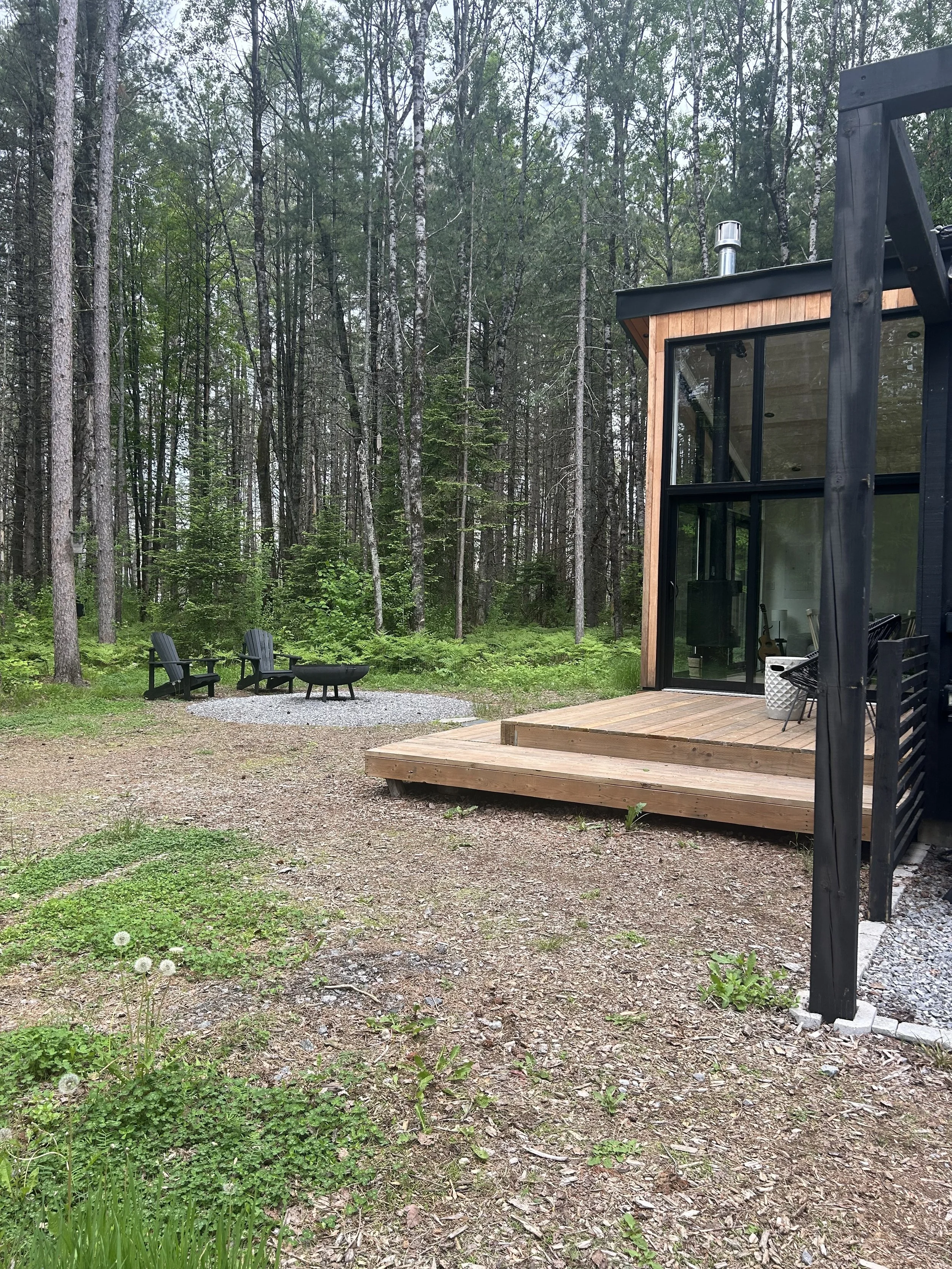
Better than you'd expect. We stayed at Heirloom Tiny Home near Elora and it felt like a complete home, just edited down to the parts you actually use.
It sits on 23 acres in Wellington County, about an hour from Burlington. Pond out front, horses and sheep grazing in your view, aspen and pine all around it. Indoor fire, a bathroom that genuinely felt like a spa, and a bed I did not want to get out of.
And here's the part that stuck with me. Nothing was missing, and nothing was extra. Every single object in that home had earned its place. No drawer of things we might need someday. No shelf of stuff that lives there because there was room for it.
That bathroom is a perfect example of something I tell clients constantly. It was small. It also felt better than most primary ensuites I walk through, because the finishes and the light were right. A small bathroom done well beats a big one done cheaply, every time. Same goes for kitchens. Size is the easiest thing to fix on paper and the least important thing in practice.
We've now done a couple of these tiny house stays and the pattern is always the same. Day one you think about the size. By day two you've stopped noticing it entirely.
Why do smaller homes feel completely normal in Europe?
Because they were built around how people actually live. In France, smaller square footage is the standard, and nobody experiences it as a compromise.
I grew up in France. Small kitchens, apartments, homes where the square footage would make a North American buyer nervous. I didn't think anything of it, because that was just what a home was.
Then you land in North America, where everything is supersized. The house, the fridge, the garage, the lifestyle. Bigger became the default goal, and hardly anyone stopped to ask why.
The thing about European homes is that they were never meant to hold your entire life. Life happens outside. In the café, the market, the park, the street. Your neighbourhood is an extension of your living room.
Which is, honestly, the entire idea behind The Village. Your home is not just the four walls. It's the trails, the coffee shop, the neighbours, the people who know your kids' names. When the community is doing part of the work, you need less house. That's the move.
Is bigger always better when you're buying a home in Burlington?
No. A well designed 1,600 square foot home often lives larger than a 2,500 square foot home with awkward flow, dead corners, and no storage.
I say this as someone who sells homes in Burlington for a living, and who has walked through hundreds of them.
Some of the smaller homes in Aldershot and Brant Hills and around downtown Burlington live enormous. Great flow, real storage, rooms that open into each other, light coming from more than one direction. You walk in and your shoulders drop.
And I have been in much larger homes that feel tight, because the space was chopped up into rooms nobody uses. Square footage on paper, wasted in practice.
Then there's the part nobody puts in the listing. A bigger house costs more to heat, more to furnish, more to maintain, more in property tax, and more of your Saturday. That's real money and real hours, every single year you own it.
So the question I ask buyers is not how much space do you want. It's which rooms did you actually use last week. The answer is usually three or four. Sometimes two.
If you're at the front end of that thinking, the buyer resources at explorethevillage.ca/buyers are a good place to start sorting out what you actually need from what you've been told to want.
What should families look for instead of square footage?
Storage, flow, and light. Those three things decide whether a home feels calm or chaotic, no matter how many square feet are on the listing.
Storage first, always. Built ins, a real mudroom, a pantry, closets that go deeper than a coat. Storage is what keeps a home from developing surface clutter, and surface clutter is what makes a house feel small and stressful regardless of size.
Flow second. Can you see the kids from the kitchen. Can you get groceries from the car to the counter without a hallway obstacle course. Does the main floor work as one connected space or four disconnected ones.
Light third. A bright 1,400 square feet beats a dim 2,200 every time, and it is not close.
One really good gathering space will outperform three formal ones your family avoids. I have watched it play out over and over. The house does not need to be big. It needs to work.
Can you put a tiny home on land in Ontario?
Sometimes. Tiny homes are permitted in parts of Ontario, but rules vary a lot by municipality, so zoning, permits, and servicing need checking first.
This is the question I get most when I talk about this, so let's spill the tea on it honestly.
Some municipalities have minimum dwelling sizes. Some allow additional residential units on an existing property, which has opened things up in recent years. A tiny home on wheels is often classified as a recreational vehicle rather than a dwelling, and that distinction changes everything about where you can put it and whether you can live in it full time.
Then there's the practical layer. Septic, well or municipal servicing, hydro, road access, and whether the land is even zoned for a residence at all.
None of that is a no. It just means you check the specific municipality before you fall in love with a piece of land, not after. If you want the names of people who actually know this stuff, the Village partners list is where I keep them.
So would I actually downsize?
Not right now. With three young kids, this season needs the space. But the long game is land with a tiny house on it, and I am completely serious about that.
Here's my honest position. I am not selling my bungalow tomorrow. Three kids, all the stuff that comes with them, and a stage of life that genuinely uses the room. I try to stay lean and it is still a lot.
But my dream, the one I actually think about, is land somewhere in this area with one of those tiny homes you can simply place on it. Less to maintain. More to live. A view instead of a bonus room.
I don't think that's a downgrade. I think that's the point.
And that's really what I want people to take from this. Bigger is not always better. Bigger is sometimes just bigger. The best home is the one that fits the way you actually live right now, in this season, not the one that fits the size you think you're supposed to want.
Some of my favourite clients have moved from more space into less and described it as relief. Not loss. Relief.
If you're in that place where you're wondering whether you need more space or just better space, that's genuinely my favourite conversation to have. No pressure, no pitch, just an honest look at what would make your daily life easier. You can reach me anytime, or start with the seller resources if you're thinking about what a move might look like.
Ten minutes to reset a whole home. I think about it constantly.
XO
The Village,
where we gather + grow
Frequently Asked Questions
Q . Can you put a tiny home on land in Ontario?
Sometimes. Tiny homes are permitted in parts of Ontario, but minimum dwelling sizes, zoning, and servicing rules vary by municipality. Check with the local planning department before you buy the land, not after.
Q . Is a bigger house always better?
No. A well designed 1,600 square foot home often lives larger than a 2,500 square foot home with awkward flow and no storage. Square footage and function are not the same thing.
Q . What should families look for instead of square footage?
Storage, flow, and light. Those three decide whether a home feels calm or chaotic. One really good gathering space will outperform three formal rooms your family never uses.
Q . What does a bigger home actually cost to own?
More than the purchase price. Heating, property tax, furnishing, maintenance, and cleaning all scale with size. That's real money and real hours every year you own it.
Q . Is downsizing worth it when you have young kids?
It depends on the season you're in. Some families genuinely need the room right now. Others move into less space and describe it as relief rather than loss. Start with which rooms you actually used last week.
Bigger is not always better.
The best home is the one that fits how you actually live.