How to Slow Down This Summer Without Losing Momentum

Let me tell you something that will probably feel familiar.
It's July. The kids are home.
The calendar has some breathing room in it for the first time in months. And instead of feeling relief, instead of exhaling, there's this low hum of anxiety sitting in my chest.
Because I want to slow down. And slowing down scares me.
I'm Audrey Bailey, a real estate broker in Burlington, Ontario, the founder of The Village, and a certified NLP practitioner. I did my NLP training as a personal pursuit, because understanding how the mind works and how to rewire unhelpful patterns has always fascinated me. Not for a credential. For myself.
And yet, even knowing exactly what my nervous system is doing and why, it still does it anyway.
This post is about that tension. About wanting rest and being afraid of it at the same time. And about why being honest about that might be more useful to you than another productivity framework.
Why Does Slowing Down Feel So Dangerous?
Slowing down feels dangerous when your brain has linked rest to lost momentum. That's nervous system conditioning, not reality.
Here's the thing about high achievers: we're really good at doing. So good that our identity gets tangled up in it. When you stop doing, even briefly, it can feel like you're losing ground. Like the moment you step back, everything you built will somehow unravel.
That's not logic. That's your nervous system in protection mode.
In NLP, we talk about how the brain creates associations, usually unconsciously and usually fast. You experience something, you experience something else shortly after, and your brain files them as connected. It doesn't stop to ask whether the correlation is actually real.
Last year, I took a slower summer. I was intentional about it. I wanted to be present with my kids, to breathe, to stop running so hard.
And my “fall market” was quieter than I expected.
Was it because I rested? Probably not. Markets shifted. Life shifted. Lots of factors. But my brain didn't process it that way. My brain saw: rest → slow season, and now every time I consider taking my foot off the gas, it fires a little alarm.
This is a conditioned response. And knowing that doesn't automatically dissolve it.
What Actually Happens in Your Nervous System When You Try to Rest
Rest triggers stress in high achievers because the nervous system has learned to read stillness as a threat, not because rest is harmful.
If you've ever taken a vacation and couldn't actually relax, if your brain kept pulling back to work, to lists, to everything you should be doing, this is why.
Your nervous system's job is to keep you safe. It learns what "safe" looks like from your patterns. And if you've spent years building safety through achievement, busyness, and constant motion, your system reads stillness as a warning signal.
Not because rest is threatening. Because it's unfamiliar. And unfamiliar registers as dangerous to a nervous system that's been running in overdrive.
The anxiety you feel when you try to slow down isn't weakness. It's your system doing its job with outdated information.
The work is in updating the information. Gently. Repeatedly. Without forcing it.
That's what I'm doing this summer.
Why Rest Is Actually a Business Strategy, Not a Luxury
Rest sharpens decision-making and client presence. For service-based business owners, burnout is a performance problem. Rest is the fix.
I know you've heard some version of "you can't pour from an empty cup." Bear with me.
Here's how I think about it now, as both an NLP practitioner and a business owner in Burlington: the version of me that rests is measurably better at this job.
She listens better. She catches things a tired version of me would miss. She makes clearer decisions. She's more patient, more creative, more genuinely present with her clients, with her kids, with everyone she's trying to serve.
The version that doesn't rest? Efficient. Gets things done. But operating from a narrower window, and clients feel that even when they can't name it.
Real estate is a relationship business. What sets a good broker apart isn't transaction volume. It's the quality of presence they bring to what is, for most people, one of the biggest decisions of their life.
You can't bring your best to that when you're running on fumes and calling it fine.
If you're thinking about buying or selling in Burlington this year and want to work with someone who actually operates this way, explore buyer resources here or start with seller resources here.
How to Build a Summer Hybrid That Works
A summer hybrid means protected "off" windows paired with clear availability hours: rest and reliability, without choosing between them.
So what does this actually look like in practice?
For me, a slow summer doesn't mean disappearing. It means being clearer about when I'm present and when I'm not. Protecting mornings at home with my kids. Not treating every notification like an emergency. Doing fewer things, and doing them better.
It also means being honest with the people I work with about what to expect, not as an apology, but as a reflection of how I want to show up.
The best service providers I keep returning to aren't the ones who are always available. They're the ones who are fully present when they're on. Constant availability without presence isn't service. It's noise.
I'd rather be the person who's truly there when I'm there.
If you're looking for trusted local partners in Burlington (home stagers, photographers, contractors), the Village partners list has people I personally vouch for. No starting from scratch.
Why I'm Saying This Out Loud
Naming the fear around rest normalizes it, for you and for the high-achieving clients who are carrying the exact same tension.
Because I think a lot of you are dealing with this too.
Whether you're running a business, raising a family, managing a career, or all three at once, you know the feeling. The guilt of wanting to slow down. The fear that something will slip if you do. The exhaustion of holding everything together while appearing like you have it handled.
I'm not here to tell you I've solved it. I haven't. I'm still rewiring, still catching my nervous system mid-flare, still choosing the lake on a Tuesday even when my brain fires off ten reasons not to.
But naming it helps. Not performing ease. Not pretending rest comes naturally to someone who's been wired for output most of her adult life. Just saying it out loud, the fear and the decision, and moving forward anyway.
That's what I want for you too.
Audrey
XO
I hope this summer gives you something real.
A Tuesday at the lake. A morning that doesn't start with your phone. A moment where you're actually there, not just physically present.
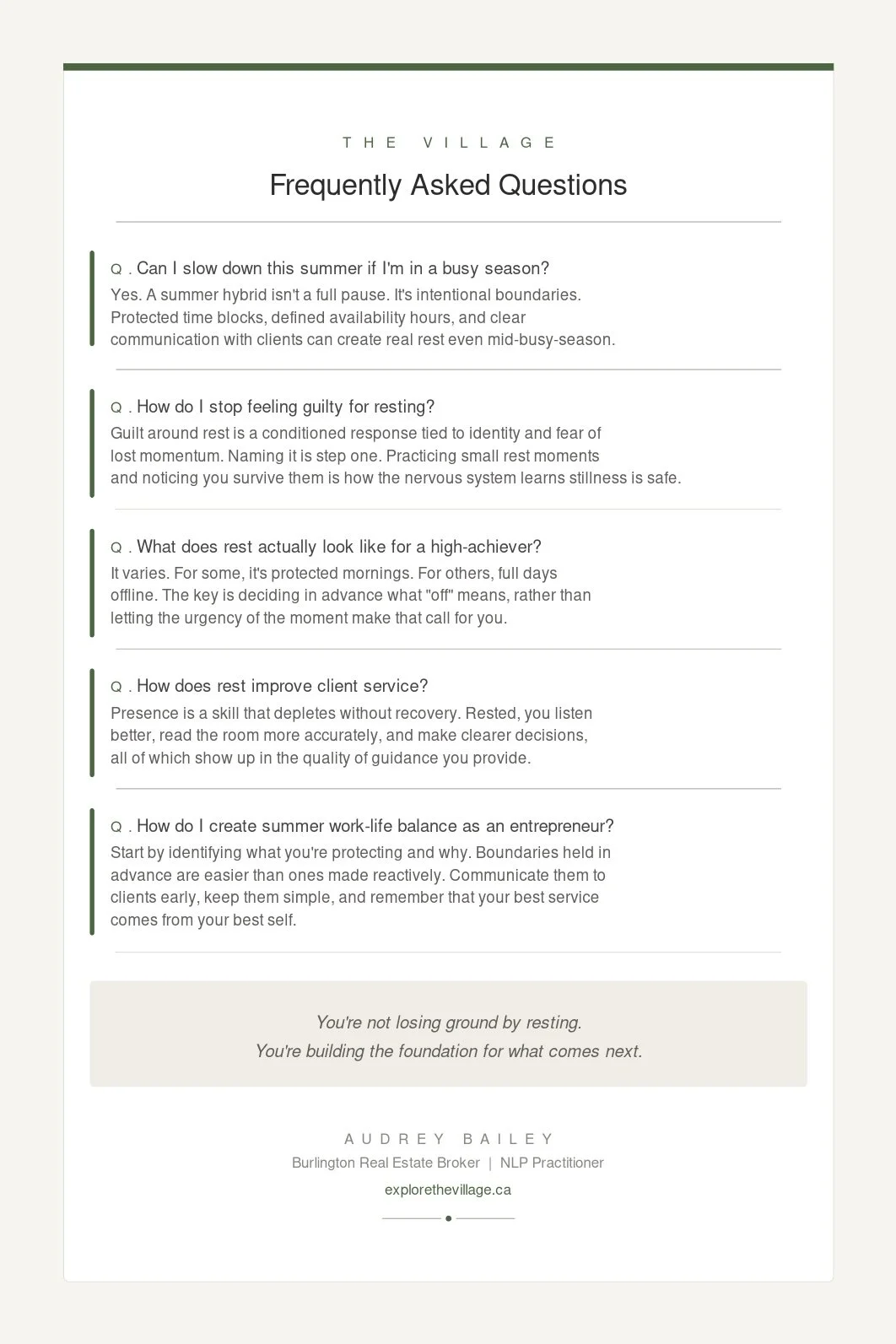
You're not losing ground by resting. You're building the foundation for what comes next.
If you want to talk about what a calm, supported real estate experience looks like in Burlington, I'm here. Start at explorethevillage.ca, or book a coffee chat if you want to go deeper together.
Audrey Bailey
Burlington real estate broker | Founder, The Village | NLP Practitioner